Sports clubs can no longer treat merchandise as something that only lives on the pitch, court or studio floor.
Across the UK and the US, fast-growing fitness communities such as padel, Pilates, Hyrox, CrossFit and pickleball are pushing clubs to rethink sports clothing, shifting the need from performance wear to creating a relevant lifestyle brand.
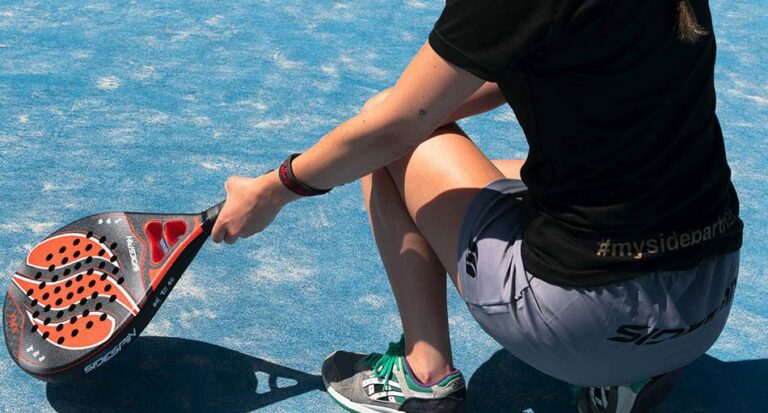
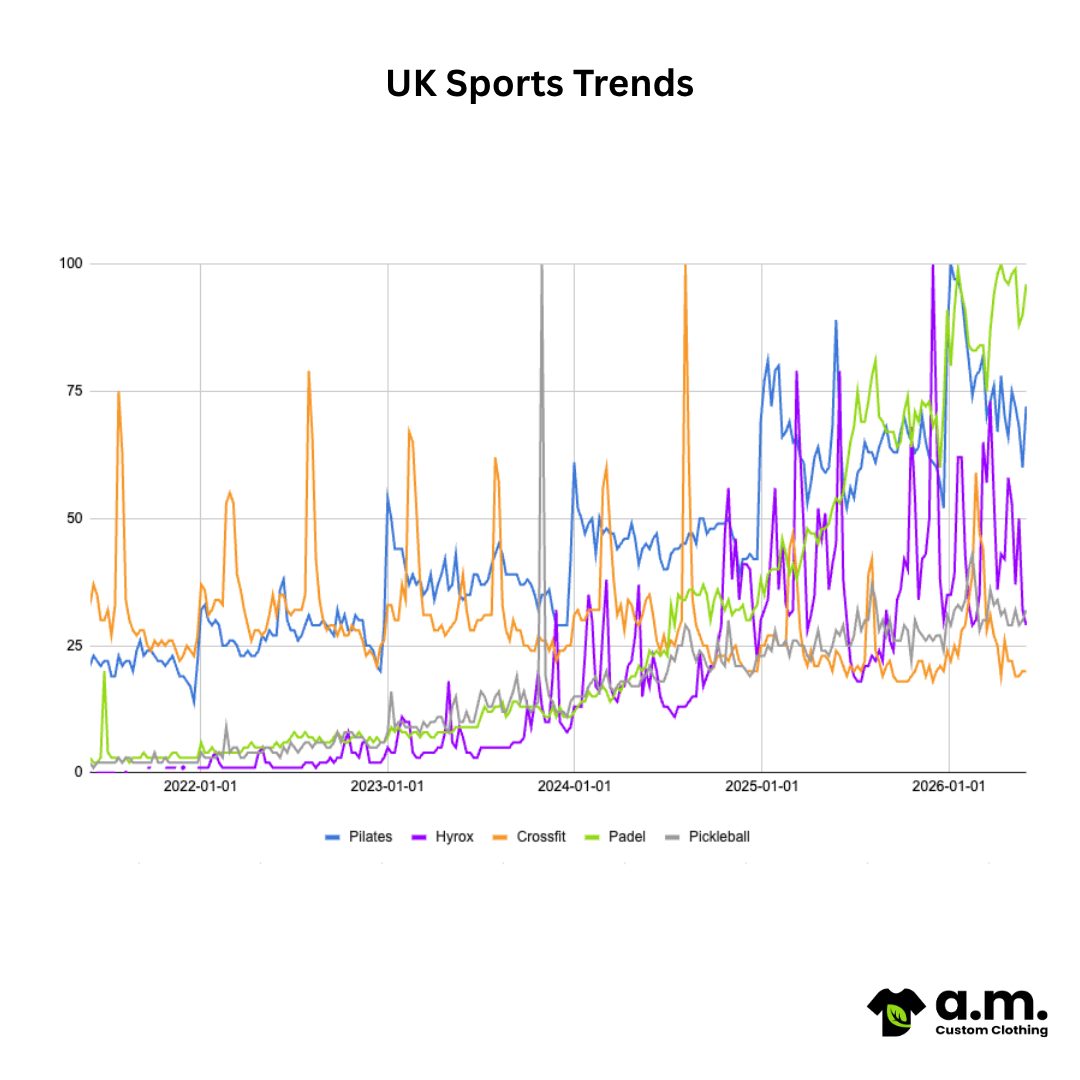
Out of these emerging sports, padel is the clearest example of how quickly they can take off and influence consumer clothing choices. In Britain, participation more than doubled in 2025, reaching 860,000 players. Venues grew by 90% between 2024 and 2025, while courts increased from 870 to 1,553 over the same period.
But it’s not only padel that is bringing more people through the door. The wider fitness market is growing too, with UK health and fitness memberships rising from 9.9 million in 2022 to 11.5 million in 2024. As more sports work their way into people’s routines, club merchandise has to feel as wearable outside a session as it does during one.
To understand how this growth is translating into clothing demand, A.M. Custom Clothing created theSports-Fashion Interest Index, drawing on Google Trends data, UK search volume data and internal enquiry data to assess how fast-growing sports are shaping demand for athleisure apparel, custom sportswear and sustainable club merchandise.
The athleisure apparel influence on sustainable sports club merchandise
As popularity in padel, Pilates, Hyrox, CrossFit and pickleball spreads internationally, interest in the UK has grown too. People may start by searching for where to play, how to train or what the sport involves. But as they adapt to the sport, the next question, sooner or later, is what to wear.
Padel is setting the pace as Britain’s most fashion-driven emerging sport
Padel is where the link between sport and clothing demand is, well, striking.
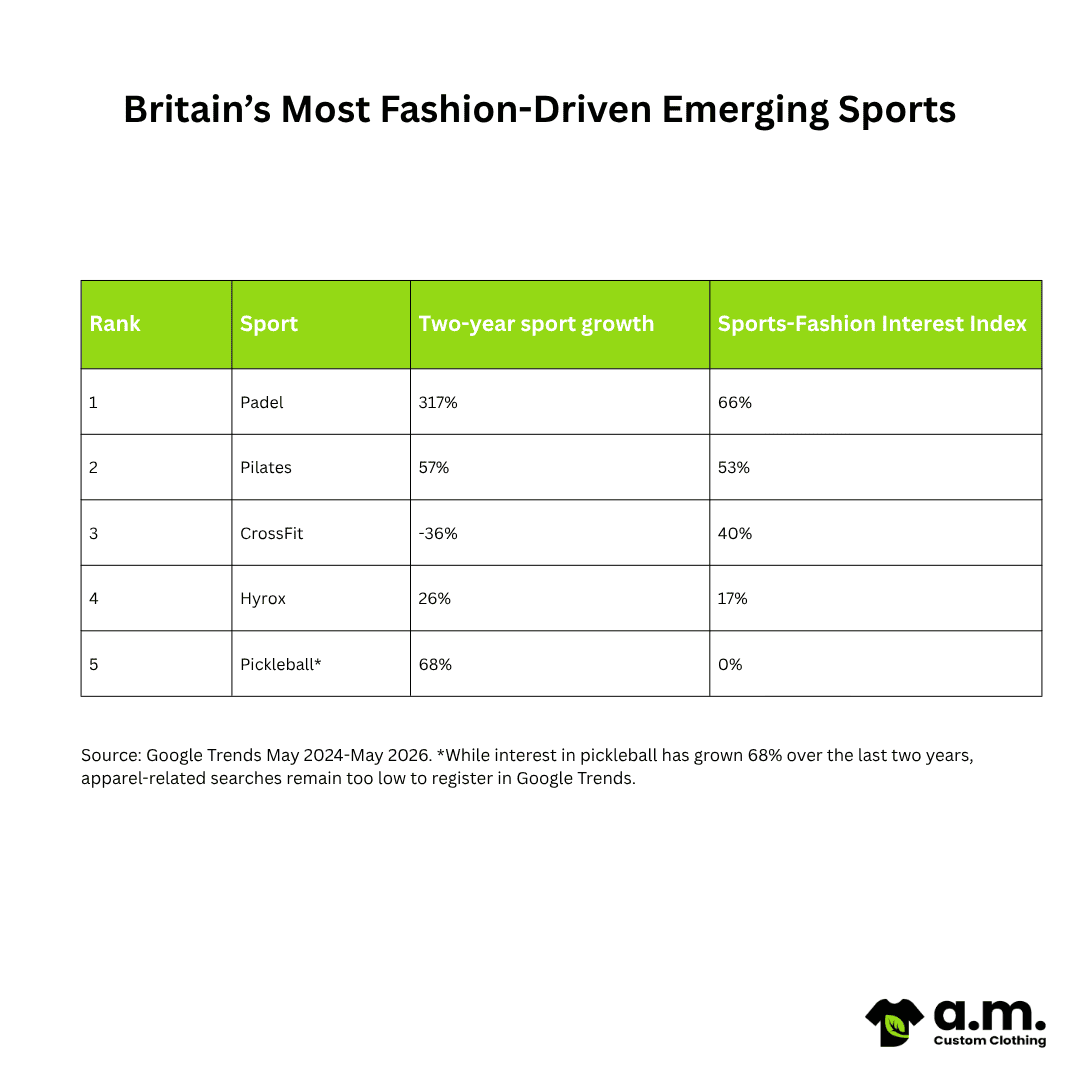
On the index, padel is the most fashion-driven emerging sport analysed. Interest in padel apparel is equivalent to almost two-thirds of overall interest in the sport, giving it a Sports-Fashion Interest Index of 66%.
That clothing demand makes sense when you look at how quickly the sport itself is growing. In the UK, search interest in padel has risen by 317% over the last two years, while searches for padel-specific clothing have grown by 29% in the same period.
Padel is not just filling the courts. It’s spilling into wardrobes too. Turning club clothing into something players want to wear long after the final point.
Pilates proves athleisure isn’t just a racket-sport trend
Padel may lead the index, but Pilates demand shows how this trend is moving beyond court sports.
In the UK, interest in Pilates has grown by 57% over the last two years, with more than 5,000 studios now operating across the country. And the aesthetic is part of the appeal. Pilates is the second most fashion-driven emerging sport analysed, scoring a Sports-Fashion Interest Index of 53%.
CrossFit and Hyrox follow on the index at 40% and 17%. Although they are not driving the same level of clothing demand as padel or Pilates, their scores show that sport-related apparel searches are emerging across more than one type of fitness community.
Pickleball shows growth does not always mean apparel demand
Pickleball makes an interesting comparison. In the UK, interest in the sport has grown by 68% over the last two years, making it the second fastest-growing sport analysed after padel.
But its apparel market appears to be at a much earlier stage. While interest in pickleball is rising, apparel-related searches remain too low to register in Google Trends. Could pickleball be the next apparel market to watch?
Athleisure is reshaping sports club merchandise
For a long time, sports club merchandise had a very clear job: it was there to be trained in, competed in and worn as part of the team.
That still matters. But as sports communities grow more lifestyle-led, clubs are starting to think beyond traditional teamwear, building merchandise ranges that feel closer to everyday athleisure than standard sports kit.
That change makes sense. As health and fitness become more visible parts of daily life, people are dressing differently to accommodate them. Comfort, practical design and more relaxed fits all play into it, with searches for athleisure wear increasing by 223% over the last two years. The term now attracts around 28,800 annual searches in the UK.
Training is no longer boxed into the hour someone spends exercising. It has become part of the commute, the coffee stop, the weekend plan and the clothes people reach for day to day.
What the order data shows and what sports clubs are asking for now
Demand for lifestyle-led sports apparel presents a commercial opportunity that’s hard to ignore. Between 2024 and 2025, A.M. Custom Clothing saw sports community unit orders increase by 189%, while sports community revenue rose by 121% year on year.
Our order briefs are starting to look different, as clubs are moving away from traditional teamwear and investing in merchandise collections designed for everyday wear.
Sports communities are still ordering clothing for members, but the emphasis is moving away from purely performance-first, polyester-focused kit.
At A.M. Custom Clothing, we are seeing more demand for:
- sustainable apparel
- premium blanks
- oversized fits
- community merchandise
- online merch shops for larger club orders
- fulfilment solutions
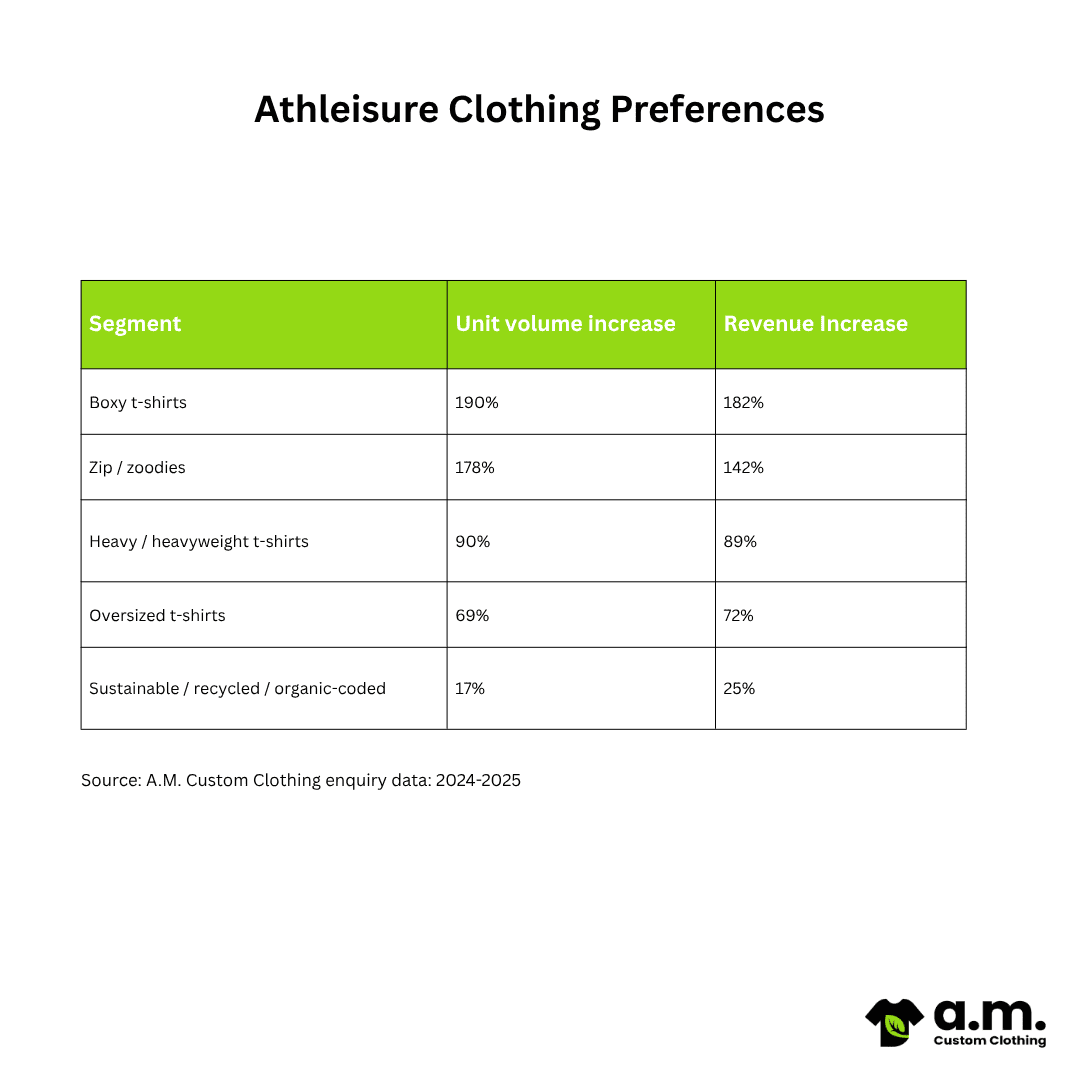
Clubs are ordering garments that fit this more lifestyle-led brief. Boxy T-shirts have seen unit volume rise by 190% over the last two years, while oversized T-shirts are up 69%. Heavyweight T-shirts are up 90% too, pointing to a clear preference for heavier, more relaxed pieces over conventional sportswear.
That shift has a sustainability angle as well as a commercial one. When clubs choose more wearable garments, merchandise is more likely to stay in members’ wardrobes and be worn repeatedly, supporting the wider fashion industry’s move away from short-term, disposable clothing.
It also changes what club clothing can do. A lifestyle brand-led hoodie, T-shirt or relaxed-fit layer can help members show they belong to a community, not just give them something to wear for training, competitions or match days.
Material choice
Material choice matters here, too. Premium cotton, organic and recycled options give clubs a way to create merchandise that feels better to wear and works harder from a sustainability standpoint.
The benefit is simple: if members actually like the clothing, they are more likely to wear it again and again. That helps sports merchandise move away from throwaway, short-term kit and towards pieces with a longer life.
Better materials, better fits and garments people want to keep are all part of making clothing less disposable.
The rise of sustainable club merchandise
For many sports clubs, it is no longer enough for merchandise to just look good or carry the right logo. The way it is made matters too.
Sustainability is becoming one of the most requested features in A.M. Custom Clothing’s community apparel enquiries.
We’re seeing this in a few ways:
- Padel clubs are choosing organic and recycled garment options, giving members pieces that better reflect the community’s values.
- Functional fitness organisations are asking for sustainability credentials up front, ensuring their products align with the standards their brands and members stand for.
- Sports communities are looking for premium garments designed for longer-term wear, giving teammates pieces they can keep wearing beyond the session and feel proud to use as part of the club’s identity day to day.
It shows a clear change in expectation across fashion and sports apparel. Sustainable options are expected by many clubs, brands and consumers from the start of the brief, rather than being treated as a premium add-on once the design has been agreed.
Alex Franklin, co-founder at A.M. Custom Clothing, explains:
“Five years ago, most clubs wanted a logo on a performance T-shirt. Whereas now, sports communities are prioritising how club merchandise is made, not just how it looks. Sustainability has moved from being a nice-to-have to something clubs expect us to discuss from the very first conversation.Sustainability is factored first alongside quality, fit and a design members actually want to wear on a Saturday afternoon.”
That focus is also changing how some clubs think about lead times. For customers who prioritise sustainability, the fastest option is not always the right one.
“In many cases, customers are willing to extend deadlines if it means securing the most sustainable product option available, ensuring the garments align with the values of their community and brand.”
Pilates, Padel and CrossFit are leading the global athleisure shift
The link between sport and clothing demand is not limited to the UK. Across the UK and the US, the index suggests that emerging sports communities are influencing apparel-related search behaviour, although the relationship appears more established in the US.
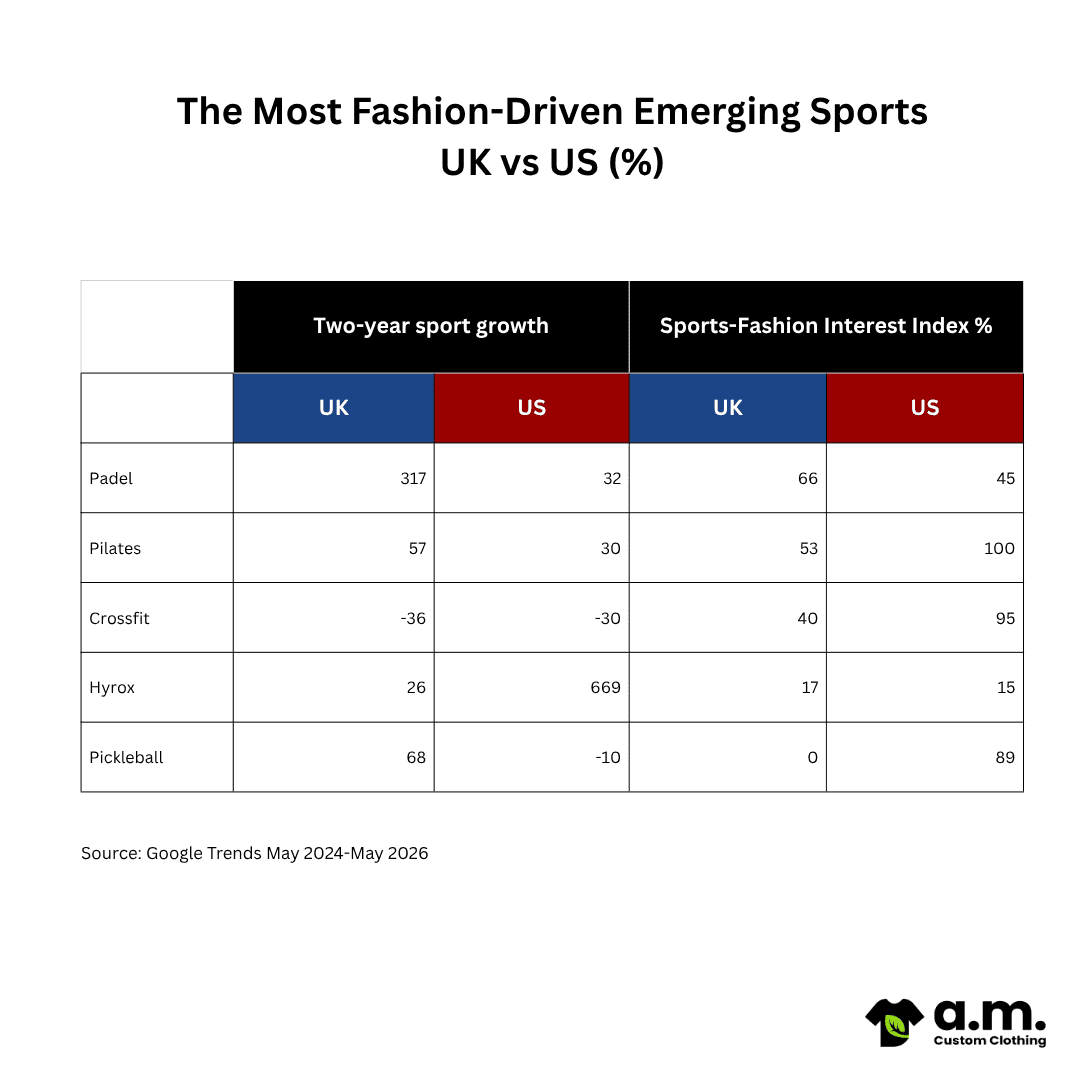
As the UK results show, padel is currently the strongest link between sport and apparel interest, leading the index at 66%. In the US, that link is more established across several sports. Pilates tops the index at 100%, followed by CrossFit at 95% and pickleball at 89%, suggesting these communities are already having a stronger influence on what people search for and want to wear.
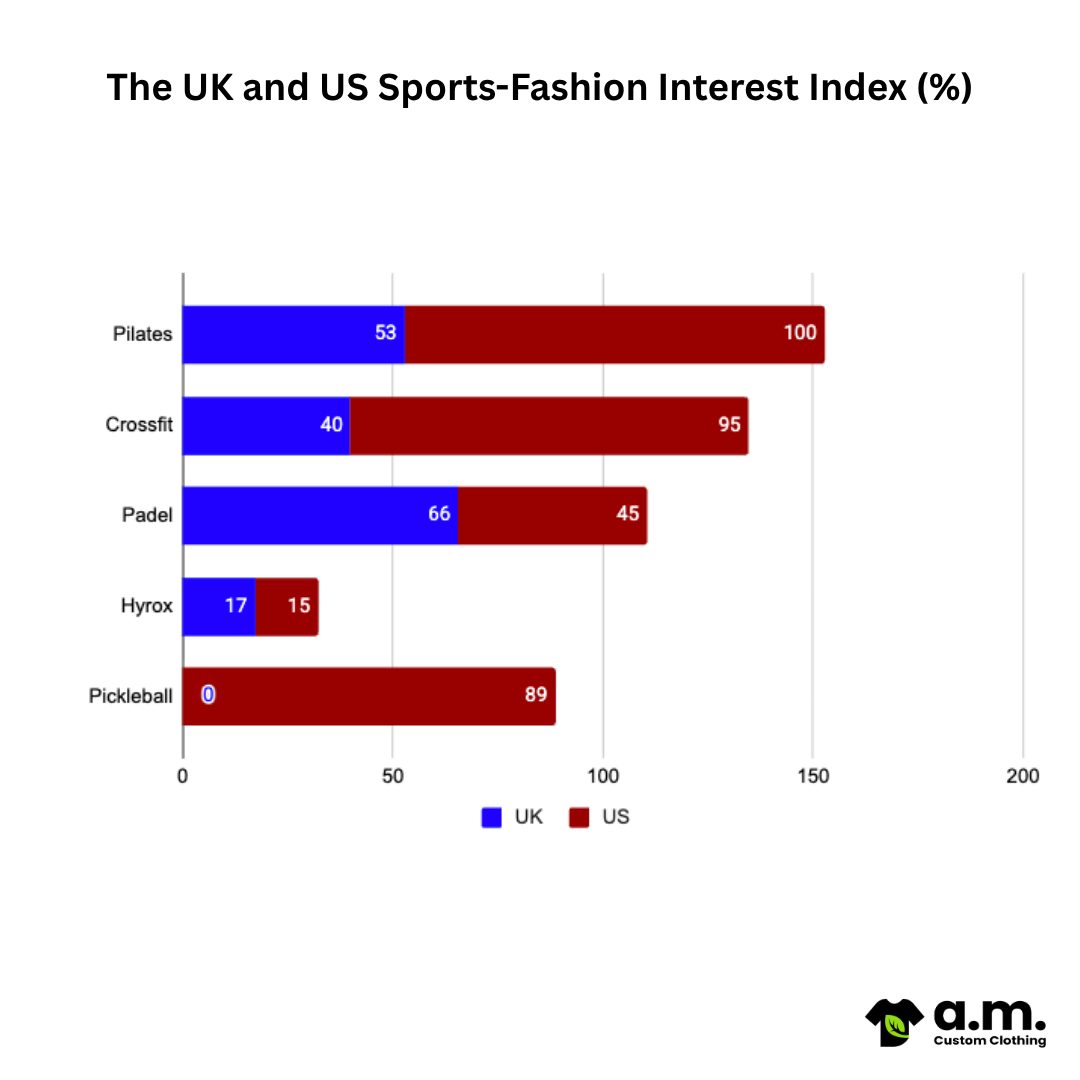
That difference matters because the index is not simply showing which sports are growing fastest. It shows where sports interest starts to translate into clothing demand.
When growth turns into clothing demand
Hyrox is the clearest example. In the US, it is the fastest-growing sport analysed, with interest up 669%, but its Sports-Fashion Interest Index is only 15%. A sport can be booming without becoming a wardrobe staple.
The pattern seems less about how fast a sport grows and more about how easily it fits into daily routines. Athleisure demand appears to build more strongly around sports such as padel and Pilates, where clothing has to work before, during and after the session.
Together, the data shows two markets at different stages, but moving in a similar direction. In the UK, padel is leading the link between sport and apparel interest as participation continues to increase. In the US, that relationship appears more established across several lifestyle-led communities, with Pilates, CrossFit and pickleball showing the strongest sports-fashion attachment.
That gap shows just how much room there is for the UK market to grow. If emerging sports communities follow a similar path to the US, apparel search interest could roughly double relative to overall sport interest as the market matures.
Alex Franklin, co-founder at A.M. Custom Clothing, explains:
“Many clubs are now approaching merchandise in the same way consumer lifestyle brands approach products. They’re thinking about quality, design, sustainability and how members engage with the brand beyond the sport itself.”
Shifting from performance wear to lifestyle merchandise
The takeaway for clubs is that merchandise is moving from ‘you need this for training’ to ‘I want one of those.’
That changes the brief for organisations who traditionally invested in polyester-based performance wear. The strongest ranges are not built around what members have to wear, but what they would actually choose. A well-made organic cotton hoodie, T-shirt or relaxed-fit layer can carry the club into everyday life, while online stores make it easier for members to come back, buy again and stay connected.
For sports communities, the real opportunity lies in that shift. Quality and sustainability are becoming basic expectations, not bonus features. Get the clothing right, and it stops being just merch. It becomes part of why people feel connected to the club and a way for sports organisations to strengthen communities, generate additional revenue, and build lifestyle brands that members genuinely want to wear.
The next generation of successful sports clubs won’t be recognised solely by their facilities or coaching, but by the communities they build around them. Club merchandise is becoming one of the clearest expressions of that community — turning club clothing from a need into a long-term, desired brand asset.
“The clubs creating the strongest merchandise programmes aren’t trying to sell kit. They’re building lifestyle brands people genuinely want to be part of. They’re focused on creating garments that members feel proud to wear regularly. That naturally places greater emphasis on quality, sustainability and longevity of athletic clothing.”
Ready to bring your ideas to life? Create a premium team kit for members to stand out, on and off the court. Get in touch today, we’d love to help.
Methodology
Google Trends data from the UK, US and worldwide was analysed for Padel, Hyrox, Pilates, Pickleball and CrossFit, alongside clothing-related searches for each sport. Growth was measured over the latest two-year period using the earliest and latest available trend values, with clothing searches using a minimum starting value of 10 to avoid distortion from low search volumes. The Sports-Fashion Interest Index compares clothing search interest with overall sport interest, supported by A.M. Custom Clothing enquiry data.