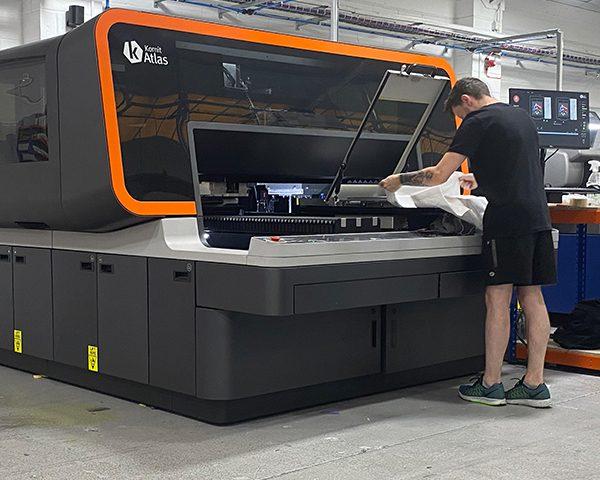
Direct to Garment printing (DTG) is a modern process that prints full-colour designs, logos, and artwork directly onto garments using specialised inkjet technology. This method allows for high-quality, detailed prints with an unlimited colour range, perfect for complex designs or photographic images.
If you’re a business or brand looking to invest in high-quality branded clothing or merchandise customised with DTG printing, then you likely have some questions you’d like answering ahead of making your investment. These questions are often associated with common misconceptions or myths around DTG printing. Is there any truth in the idea that DTG prints will fade over time..? Or that it only works on white T-shirts…? We’re here to help clear up any uncertainties you may have around these questions and more.
At A.M. Custom Clothing, we’re experts when it comes to DTG printing, with years of experience printing for some of the world’s biggest brands. So, let’s delve into the common myths you may have come across during your research to see whether there is any truth to them.
“Is DTG Printing Only for White T-shirts?”
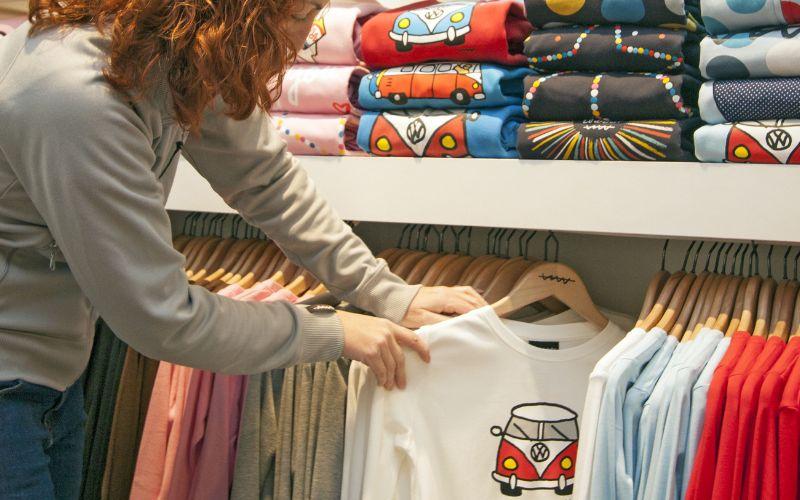
No, DTG printing is not only for white T-shirts. Modern DTG printers have the ability to produce vivid, full colour printing on nearly any colour of fabric, including those of darker shades. The use of a white ink base layer means that DTG printing can work on darker coloured garments just as effectively as on lighter colours. DTG printing is not just limited to use on T-shirts and can produce high-quality decoration on a range of other garments, such as hoodies and sweatshirts.
Key Takeaways:
- DTG printing is not limited to white T-shirts
- Modern DTG printers can produce vivid, full colour prints on fabrics of any colour, including dark shades
- White ink base allows designs to stand out on darker garments
- DTG printing can be used on a variety of clothing types such as hoodies and sweatshirts, not just T-shirts
- The method delivers high-quality, detailed decoration across different fabric colours and garment styles
“Do DTG Prints Not Last Long?”
It’s a common misconception that DTG printing does not last long or that the prints can peel off. But when high-quality machinery and inks are used, this simply is not the case.
Unlike heat transfer vinyl or digital transfer prints (for which DTG is often confused with), DTG inks bond directly into the fibres of the fabric, ensuring a durable, lasting finish that, if done right, shouldn’t peel or fade. Ultimately, the print should last the lifetime of the garment if looked after appropriately.
When high-quality inks and proper curing are used during the printing process, DTG prints can last just as long as traditional screen prints, maintaining their quality and vibrancy over time.
The image below on the left was taken straight after the T-shirt was printed. The image on the right is a photo of the same T-shirt taken over a year later (after being worn and washed regularly for a full year – at least 20 washes). While there are some slight differences due to the lighting and angle being slightly different, it’s clear to see that the print quality is still almost exactly the same as it was after being printed, having been worn and washed.
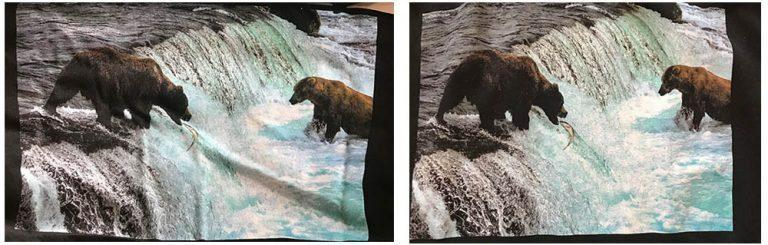
Of course, correct garment care is also required to prolong the lifespan of your DTG print. Wash tests have proven that DTG prints retain their quality for dozens of washes without fading when printed on organic cotton and cleaned inside out, on a cold water wash.
If you’ve seen DTG printing in the past and it’s not been high quality or durable, don’t be deterred from this process; it’s likely down to inferior machinery or a lack of print expertise.
Key Takeaways:
- DTG printing does not peel or flake away when done correctly
- It is a misconception that DTG prints do not last long
- With high-quality inks and proper curing, DTG prints can last as long as screen prints
- Correct garment care is important to extend the lifespan of DTG prints
- Wash tests show DTG prints retain their quality for many washes without fading
- Best results are achieved when printed on organic cotton and washed inside out on a cold water cycle
“Will I be able to perfectly match Pantone colours if I opt for DTG printing?”
Many assume that DTG printing can perfectly match Pantone colours or the colours seen on their digital screen, and whilst we can get close to these colours, the process does have its limitations.
Unlike screen printing, which relies on Pantone references to mix the inks into the right colour, DTG printing typically works from artwork provided in RGB format. This often leads to confusion, as DTG machines don’t typically print using RGB inks. The reason behind this is that RGB holds a much wider colour range than CMYK, especially for bright or vibrant tones.
Supplying artwork in RGB gives our colour-management systems the fullest possible information to work from, allowing the software to convert those colours into the printer’s own ink set in the most accurate way for the garment, ink and machine being used. This helps us get as close as possible to your intended colours within the limits of DTG printing, but it still can’t guarantee a perfect Pantone match.
As for why it won’t look exactly the same as on a computer screen. There are a whole host of factors at play here, but two of the more obvious ones include variation in screen calibration and the fact that screens are backlit, unlike garments, which are fabric.
Key Takeaways:
- DTG printing cannot always perfectly match Pantone or screen-printed colours
- Some spot colours, metallics and highly vibrant shades are difficult to reproduce exactly
- Fabric type, ink set and printer calibration all influence colour accuracy
- Proper colour management helps achieve the best possible match and consistency across prints
“Is DTG Printing Eco-Friendly?”
DTG printing is one of the most sustainable printing methods on the market, using water-based, non-toxic inks and producing minimal waste. It also requires no screens or harsh chemicals, helping to reduce environmental impact. One of the major advantages of DTG technology is that it allows printing with no minimum order quantities, unlike screen printing, which typically requires larger runs due to setup processes. This flexibility means garments are only produced when needed, helping to minimise overproduction and waste.
That said, like all printing methods, DTG does use energy during the printing and drying process, so it’s not entirely impact-free. However, when combined with ethically sourced garments and renewable energy, DTG remains one of the most ethical and eco-friendly printing options available.
Key Takeaways:
- DTG printing is one of the most sustainable printing methods available
- It uses water-based, non-toxic inks and produces minimal waste
- No screens or harsh chemicals are required, reducing environmental impact
- Many DTG printers have no minimum order, helping prevent overproduction and excess waste
- When combined with ethically sourced garments and renewable energy, DTG printing is a highly ethical and eco-friendly choice
“Can You Get Professional Quality with DTG?”
DTG can absolutely deliver professional quality when handled correctly. It can be used to produce intricate designs and smooth gradients. DTG has impressive resolution capabilities of up to 1200 DPI or higher, meaning it can deliver highly detailed prints – such as photography or detailed illustrations. Professional quality in DTG printing is defined by sharp detail, colour accuracy, durability, feel and consistency, all of which depend heavily on the machinery, inks and expertise behind the process.
The quality of DTG printers can vary significantly; you can purchase a basic machine for a few thousand pounds, or invest in industrial systems that cost close to a million pounds. At A.M. Custom Clothing, we operate at the latter end of that spectrum, ensuring exceptional results through advanced technology and premium inks.
Many assume that screen printing is the benchmark for quality in garment decoration, but modern DTG technology now rivals it and in the right context, can even be the superior choice. Unlike companies that offer only one print method, we provide both DTG and screen printing, allowing us to recommend the most suitable and cost-effective solution based on your specific needs rather than being biased toward a single technique.
Key Takeaways:
- DTG printing can achieve professional quality when done correctly
- Professional quality includes sharp details, accurate colours, durability, soft feel and consistency
- Advanced inkjet precision allows for intricate designs and smooth gradients with resolutions up to 1200 DPI or higher
Is DTG Printing right for you?
Direct to Garment (DTG) printing has evolved into one of the most advanced and versatile printing methods available today. It offers exceptional detail, vibrant full colour results and a soft, comfortable finish that rivals and in many cases surpasses traditional print techniques. While it’s not without its nuances, such as colour matching limitations and the need for correct garment care, modern DTG technology has proven to be durable, professional and reliable.
At A.M. Custom Clothing, we combine cutting-edge machinery, premium water-based inks and years of expertise to ensure every DTG print meets the highest professional standards. Our sustainable approach, combined with the flexibility of no minimum order quantities, makes DTG printing an ethical and cost-effective choice for brands of all sizes.
Whether you’re creating custom merchandise, uniforms or branded apparel, DTG printing offers the perfect balance of quality, sustainability and creative freedom, helping your designs look as good in reality as they do on screen.
Or if you have any questions, contact us today.